The first episode of The Gilded Age‘s Season 3 dropped last Sunday. It was a strong season opener that reestablished where all our favorite characters from 61st Street stand after season 2’s closing surprises. However, the most exciting part was the trailer for the rest of the season. There will be no lack of drama and the execution looks to be above and beyond, like usual for a Julian Fellowes production.
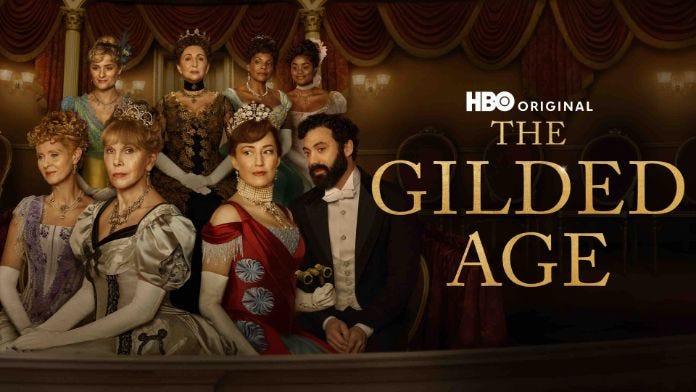
Given that this season will have even more historical references than the previous 2, let’s dive into all the topics that come up from both entertainment and educational lenses. First, a refresher on what has happened up until this point in the show.
Storyline Summary of The Gilded Age Seasons 1 & 2
The Gilded Age has undoubtedly become my favorite HBO historical drama, potentially earning the spot of my all-time favorite show. Developed by the creators of Downton Abbey, this series offers an American take on the elite class and their devoted servants. Named after the most lavish era in American history, it successfully encapsulates the opulence of the time. The allure is heightened by stunning costumes, meticulous set design, and a truly magnificent storytelling prowess.
Venturing into 1880s America, The Gilded Age immerses us in the clash between old and new money, spotlighting two influential households — the esteemed Van Rhijn’s and the nouveau riche Russell’s. Season 1 unfolds in 1882, painting a vivid picture of the rivalry between the established elite of old New York and the emerging wealth of new New York.
Julian Fellowes does a fantastic job of intertwining a bunch of storylines into a seamless production. Therefore the following summaries of the two seasons are going to be pretty bare bones with a few spoilers that I will warn of now. I encourage everyone to go watch the series for themselves to experience the full masterpiece.
Season 1 — Old New York Versus New New York
Season 1 starts with Marian Brook leaving Doylestown, Pennsylvania after her attorney Mr. Rakes informed her that her deceased father’s estate only left her $30. To add to her misfortune, she is robbed at the train station and has no money to get another ticket to New York where she is to stay with her aunts, Agnes and Ada. Marian borrowed money for a new ticket from a black woman she never met before, Peggy Scott. When they arrived in New York, Aunt Agnes asked Peggy to be her secretary, a position that included room and board.
Agnes Van Rhijn and everyone in the household is from old New York. So, when new money built an enormous and magnificent mansion across the street, chaos ensued. Agnes’ efforts to assist Mrs. Astor in holding off the nouveau wealthy intensified as her new neighbor, Mrs. Russell, rejected exclusion from the New York elite circle. Bertha Russell is propelled by an unwavering pursuit of victory, a sentiment echoed by her robber baron husband, George.
Those with status have money, but those with money do not always have an easy time acquiring status. George Russell’s business empire set him and his family far and above most of New York monetarily. “Russell has more money than God,” was one of the most memorable lines of season 1 and a statement that the show seems to illustrate as only a slight exaggeration.
The strongest part of Bertha’s personality is her ability to become laser focused on a goal. We see her develop tunnel vision when it comes to breaking into elite New York society, an advantage over her enemies but a challenge for her children.
During season 1, Gladys Russell’s coming out is used as a weapon for Mrs. Russell to achieve status within New York society. Larry Russell approached his father about wanting to become an architect rather than Mr. Russell’s shadow. Initially, George pushed back. However, it becomes clear that George is easier for the children to sway rather than their mother who is rarely persuaded unless her benefit is clear. In Season 2, we see Mr. and Mrs. Russell continue their parental pursuits of putting out (and starting) fires.
Season 2 — The Opera Wars
The first episode of season 2 opens on Easter Sunday with everyone making their way to church. This episode does an excellent job at highlighting a main theme for the series: the juxtapositions amongst race and class. Most of the characters attended St. Thomas church where the wealthy class get the pews up front. However, the Scott family attended a funeral at a black church in Philadelphia, a funeral of Peggy’s son. The first episode is hard hitting and sets the stage for several opposing storylines.
We see the world expand as George went to battle with his employees as the Labor Movement began to pick up momentum, and Peggy goes South, barely making it back with her life. Mr. Fortune and Peggy then go on to help fight the school system to keep the colored schools open. Within the white elite New York society, two very different tunes are playing: Bertha and Mrs. Astor waging the opera war and the constant buzz of marriage at the Van Rhijn’s. All the drama that people like Mrs. Fish live for.
While some these topics seem frivolous and unimportant compared to other storylines, it is true that for some this was their entire lives. For everyone, especially in a time without social media, it is easy to get sucked into your own bubble — a place where your problems are the biggest issues in your world. Julian Fellowes does an excellent job capturing the different perspectives with historical lenses, not modern ones.
While Bertha is fighting against Mrs. Astor and the Academy of Music, Larry ignites a fire than Mrs. Russell is determined to extinguish. Larry’s pursuits as an architect are going well, but life starts to get messy when he becomes romantically involved with is employer, the widowed Mrs. Blane. Mrs. Russell believes this to be Larry tarnishing his good name while Larry calls it love.
George on the other hand has a conversation with Gladys that is very unlike how Bertha interacts with the children. George gives Gladys his word that when she falls in love he will back her decision even if that means going against his wife’s wishes. Even while in the throes of his own war threatening his profits, Mr. Russell is completely invested in his family’s happiness.
Marriage during the Gilded Age was often the most important part of a woman’s life. Women has roadblocks that were easier to navigate with a husband. In the Van Rhijn house, marriage is the hot topic. Agnes is widowed but invested in her family’s dealings. There is one accepted proposal that is broken and another that results in a happy marriage.
Season 2 was a wild ride that did not disappoint even once. I’m blown away by this series, especially the characters. Larry Russell and Peggy Scott emerge as compelling characters, enriching the storyline with their personal journeys. As Season 3 kicks off, the anticipated conflicts between George and Bertha, the union of Larry and Marian, and John’s rise in society promise to keep viewers enthralled. The show’s seamless blend of historical figures with fictional characters solidifies its status as a masterpiece, leaving audiences eagerly awaiting the unfolding drama in the upcoming season.
 Reframing History